The Two Prices of a Coin: PCGS Got Half the Story
As seen on TalkMarkets. This is the full photo edition — every screen of the estimator, pictured. By Greg Mattison, SilverScoreboard Media, LLC, an Educational Organization.
Ask a coin dealer what your collection is worth and you'll get a question back: "Melt, or graded?" Those are the two prices of a coin, and for forty years the tools have only ever computed one of them at a time.
The melt side is solved. PCGS — the Professional Coin Grading Service, the big dog of third-party grading — publishes a free app called Coinflation that does exactly what it says: live silver and gold prices, melt math for U.S. silver coins, base-metal coins, gold scrap, silver scrap. It's the standard, it's free, and it belongs in every stacker's pocket.
The graded side is solved too, sort of. NumisMedia publishes Fair Market Values for certified U.S. coins in every grade from Good-4 through MS-70. PCGS CoinFacts wraps similar numbers in an encyclopedia. A collector can look up what one 1921 Morgan in MS63 traded for.
Our research indicates the family's question has outgrown those solved problems. Nobody — not PCGS, not NGC, not NumisMedia, not the photo-recognition apps like CoinSnap — built for the question the family actually asks: what is the whole collection worth, both ways, in one total?
The Dealer's Workflow, Undigitized
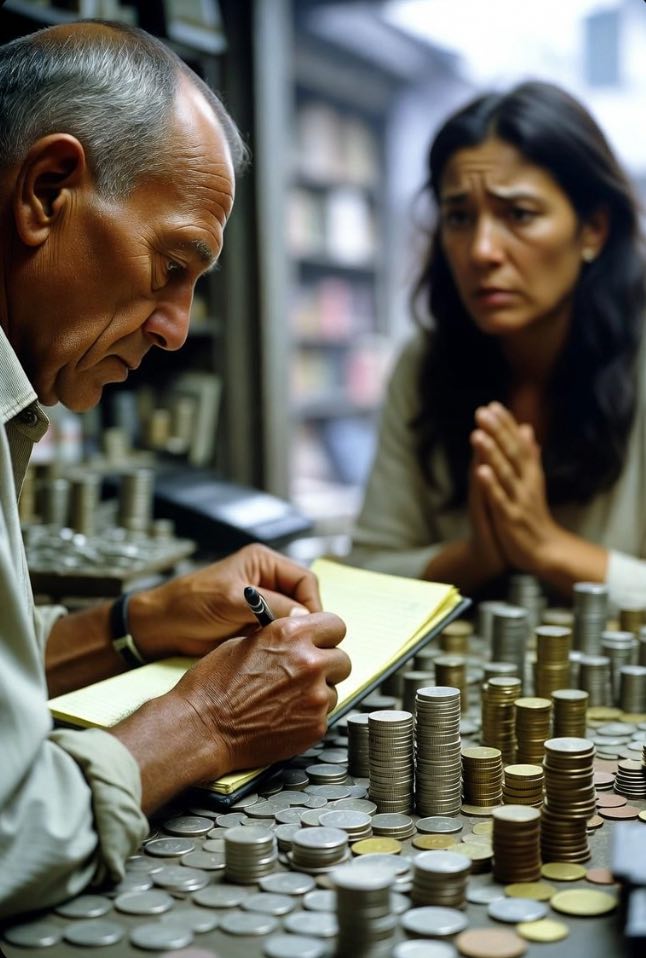
Watch a dealer work an estate and you'll see the gap. Half the coins go on a scale — junk silver, worn Morgan dollars, a jar of pre-1920 British sterling. The other half are in plastic slabs with grades on the labels, each one looked up individually, price scribbled on a pad.
Then he adds it all up. By hand. On the pad.
That pad is the last un-digitized step in a hobby that has otherwise gone digital — and it survived for a reason. The melt apps answered the melt question; the price guides answered the lookup question. Each tool solved the problem of its day, and solved it well. But our research indicates the market's needs have moved on, and an estate executor — usually a widow or a son with no coin background at all — still has no tool that answers today's question.
We built the SilverScoreboard Coin Estimator for exactly that job — and the design wasn't guesswork. SilverScoreboard Media is an educational-based company that listened to the market's demands: one unified calculator, capable of pricing entire collections, providing consumers a live valuation inventory tied to the price per ounce — a living total that moves when the market moves. It runs free in any phone browser at silverscoreboard.com/CoinCalculatorPro.
Screen One: Weigh It
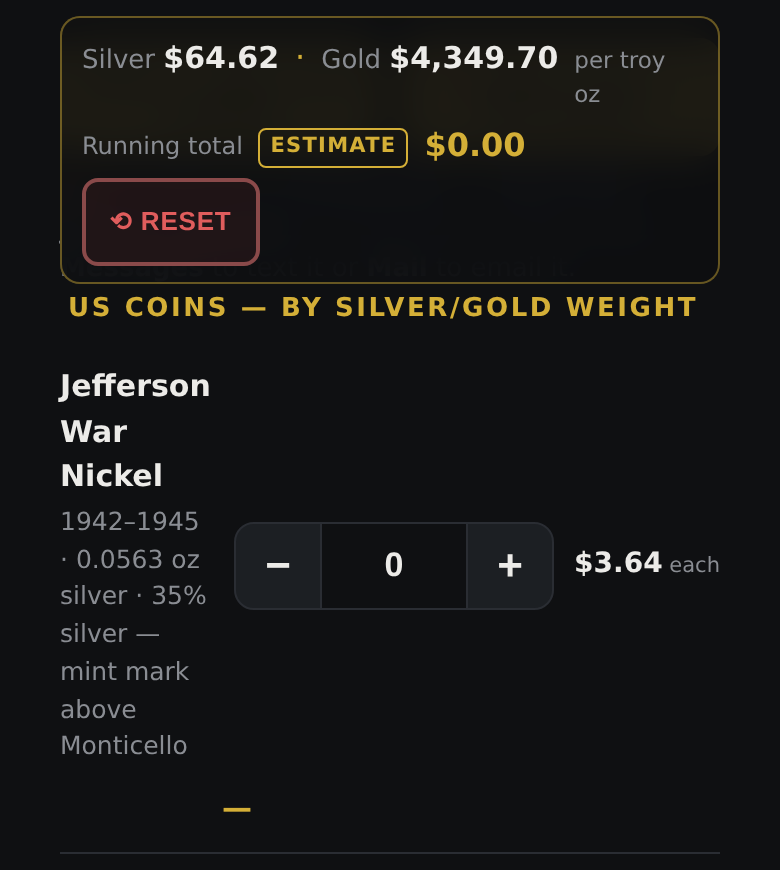
The weight screen prices U.S. coinage by live metal content — dimes, quarters, halves, dollars, the gold denominations — with a count box on each row and a running total at the top. Type a few letters in the search box and the list filters as you type; no scrolling through fifty rows to find Mercury Dimes.
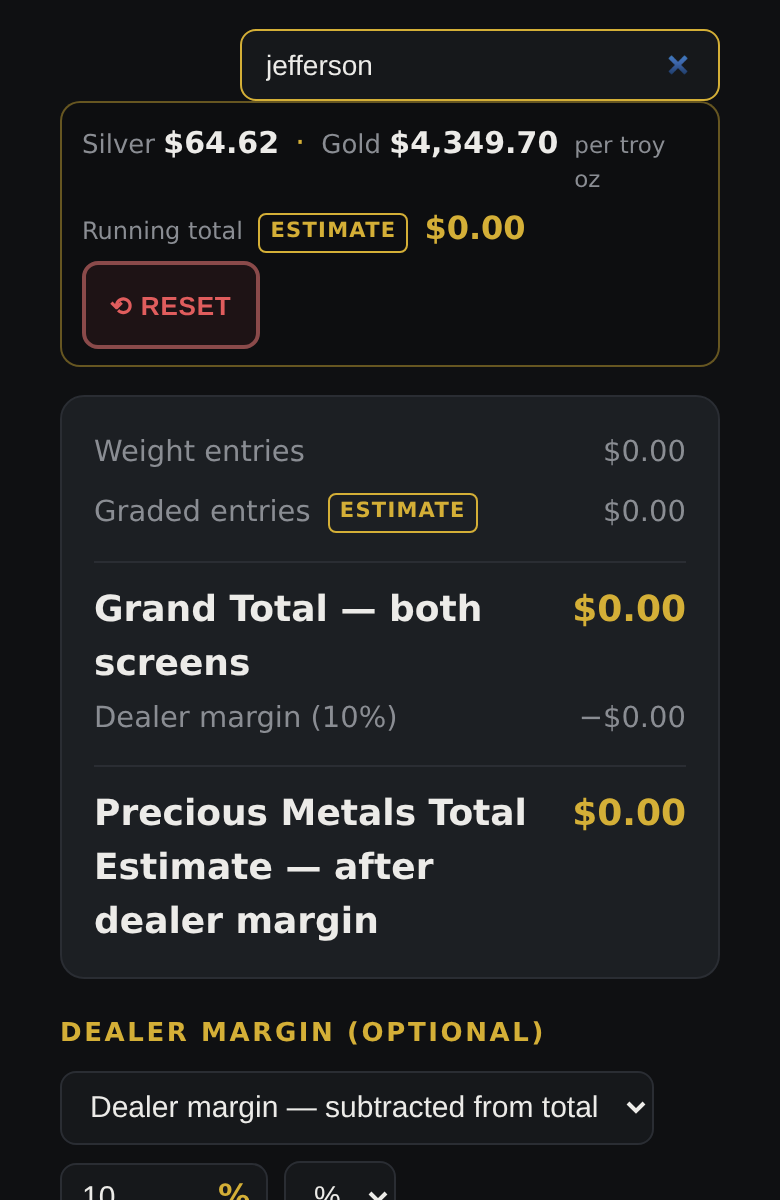
The search box earns its keep on a 101-row list: type a few letters and the list becomes your shortlist, with a count line that always says where you are. Tap a group pill and the list follows. Finding Mercury Dimes is a two-tap job now, not a scroll.
The world section is where it gets interesting for anybody who inherited coins from abroad. Fifty-four rows covering the coins that actually cross estate desks: British sterling and the 1920–1946 debased era, Canadian 80% and the one sterling year, Mexican 8 Reales — the pieces of eight — Mexican 50 Pesos, French 20 Francs and the 5 Francs Hercules, Australian pre-decimal silver and the 1966 round 50-cent, plus Austrian, Chinese, German, and Swiss coinage and the bullion staples — Krugerrands, Maple Leafs, Britannias, Libertads, and bars and rounds to 1,000 ounces.
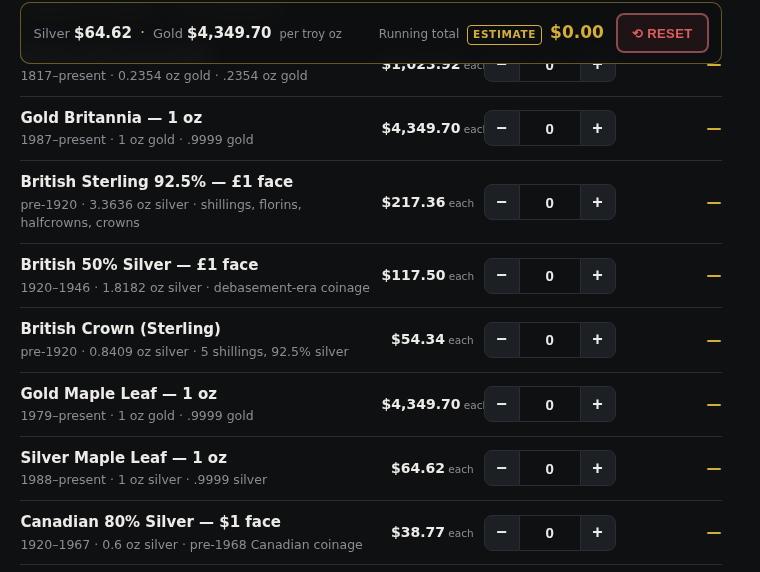
One number worth sitting with: a pre-1920 British pound face value in sterling coinage holds 3.36 troy ounces of actual silver. At this writing that's about $204 — in coins that often get tossed in a drawer as "old foreign money." The debased 1920–1946 era still holds 1.82 ounces per pound face. Foreign silver is not junk silver's poor cousin; it's just poor tooling.
Screen Two: Grade It
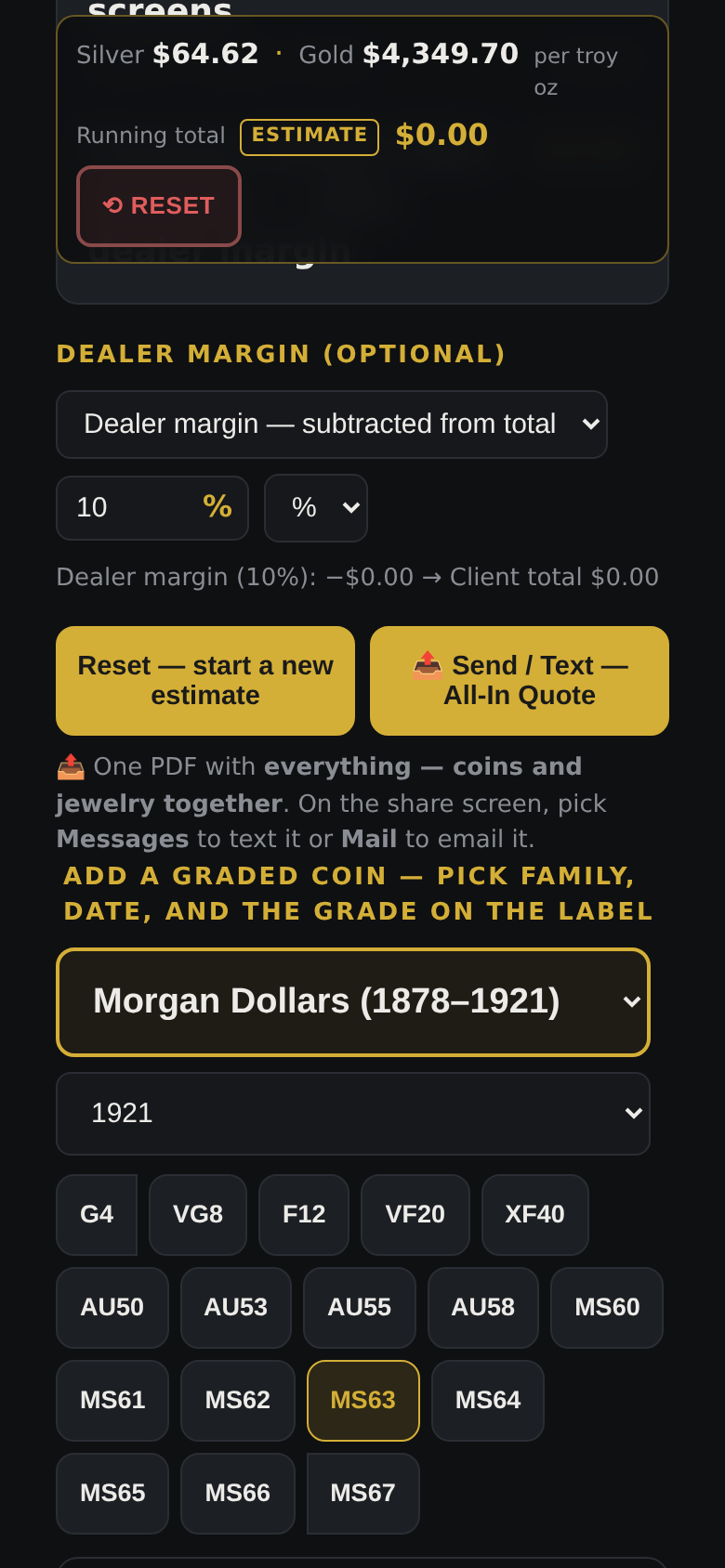
Flip to the graded screen for the certified coins. Pick the family — 98 of them, from Barber Dimes to GSA Morgan Dollars — then the date, then the grade printed on the slab label, G4 through MS67. The estimator returns the collector value from NumisMedia's Fair Market Value data, updated daily, alongside the live melt value of the same coin.
That side-by-side is the number that matters. A 1921 Morgan in MS63 carries an estimated collector value around $97 while containing about $47 of silver at today's spot. Anyone holding graded coins needs both figures to know what they have — and what a fair offer looks like.
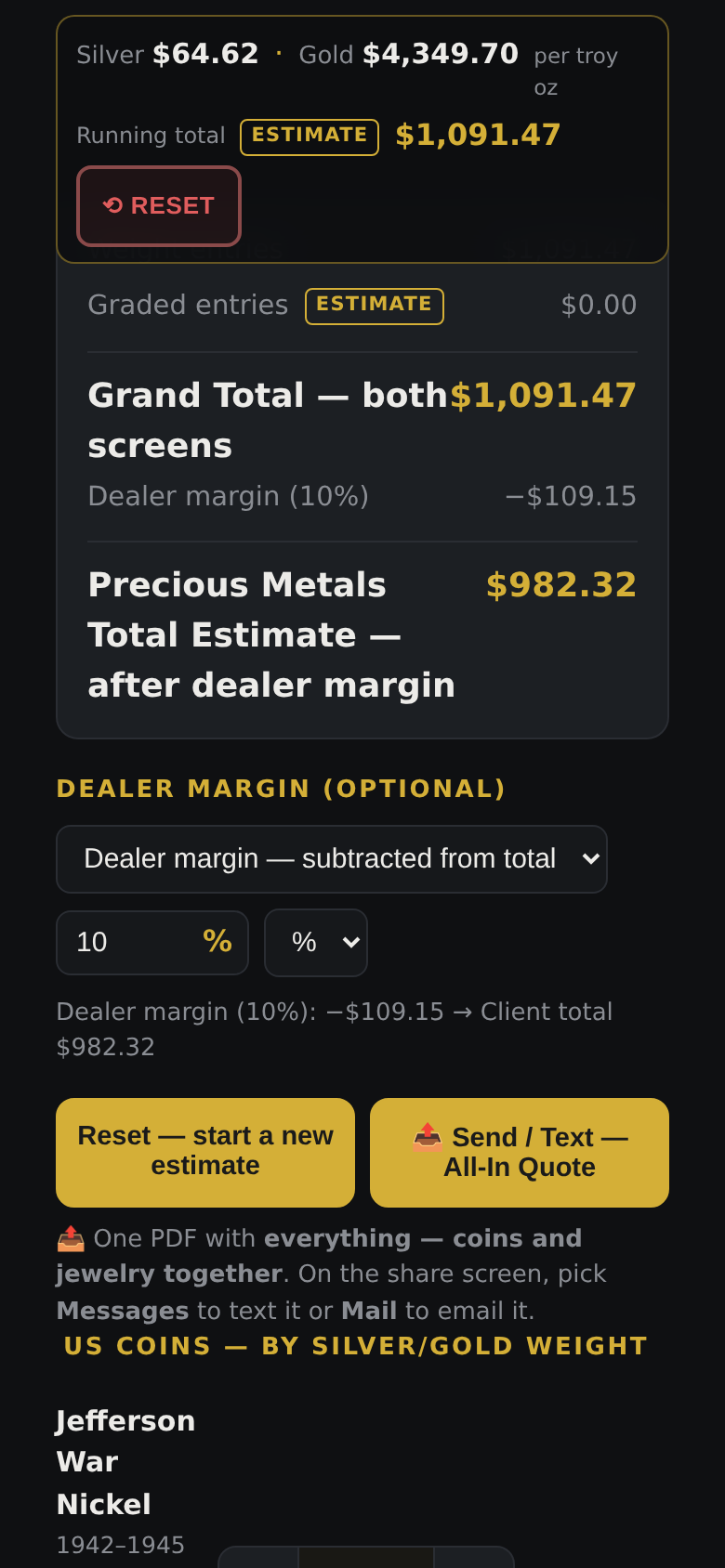
Every saved line gets its own grade dropdown and quantity stepper, so a mis-entered grade gets corrected in place rather than deleted and re-added. For professionals, a Dealer Margin window folds the shop's margin into the running totals, under whatever label the shop puts on paper. And the two screens share one running total — weight entries plus graded entries, one number. When the estimate is done, one tap produces a PDF a client can hold, print, or file with the estate paperwork.
Why the Big Guys Didn't Build It
Fair question. PCGS is in the grading business; an app that helps you value slabs without paying for grading is not obviously their product. NGC likewise. NumisMedia sells price data, not interfaces. The photo apps chase the novice with a phone camera. Each of them solved the problem it chose — and each solved it well.
Think of the tool bench. The melt apps and the single-coin guides are the standard socket set; the collection question is metric. Many benches in America have one or the other. We asked a simple question: why not both in your toolbox? That's what the Estimator is — the set that fits both. And we didn't take our own word for the difference: we investigated the calculators on the market, documented ours, and took it to the United States Patent and Trademark Office, which accepted the filing and gave the difference a number — Patent Pending, U.S. Application No. 64/139,708. Third-party verification money can't buy.
Fill that gap and the executor, the inheritor, and the honest dealer all get the same transparent number — which is, not coincidentally, how trust gets built in a market with an eternity-old reputation problem.
The Standard Caveats
Estimated collector values are exactly that — estimates, from NumisMedia FMV data, refreshed daily. Melt values track the live spot feed. Coins worth serious money deserve a professional appraisal, and nothing in a browser replaces one. What the estimator does is give the regular person a defensible starting number before anyone with a pad shows up.
Silver stacks, inheritances, and old foreign coin drawers are having a moment with silver around $60. The two prices of a coin have never been further apart — and never easier to see in one place.
The SilverScoreboard Coin Estimator is free at silverscoreboard.com/CoinCalculatorPro. SilverScoreboard is an educational organization; the Coin Calculator is patent pending (U.S. App. Nos. 64/139,708 and 64/153,526). Nothing here is financial advice.